History
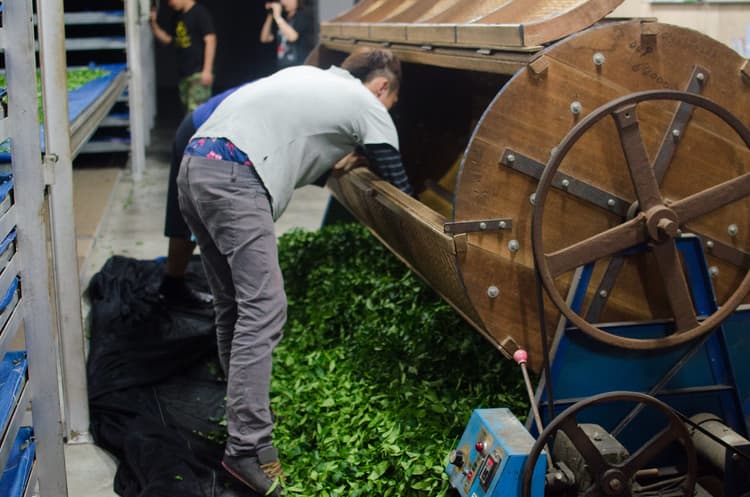
GABA tea was developed in Japan in 1984 by researchers at the National Institute of Vegetables and Tea Science. They discovered that placing freshly processed tea leaves in an oxygen-free, nitrogen-filled chamber for six to ten hours caused the leaves to accumulate unusually high levels of gamma-aminobutyric acid (GABA). Although the process was first developed using green tea, it was soon found that black, oolong, and other teas could undergo the same treatment.
The Japanese government promoted GABA tea as a functional food, particularly for people with hypertension, although research on its health benefits remains mixed. In recent decades, the tea has become especially popular in Taiwan, where producers have refined the process and now produce some of the world's best GABA teas. Today, most GABA tea is made from oolong.
Flavor
GABA tea is typically smooth and low in bitterness, with malty, savory, fruity, and slightly tangy notes. The anaerobic processing gives it a distinctive sweetness and complexity that sets it apart from similar teas that have not undergone the GABA process.
Because the process can improve the flavor of lower-grade leaves, some producers use less expensive harvests, such as summer-picked tea, although many high-quality GABA teas are also produced
Brewing
Because GABA tea is produced from many different types of tea, brewing recommendations vary depending on whether it is a green, oolong, or black GABA. Most GABA teas, however, are oolongs. In general, I recommend brewing 4–5 grams of tea gongfu style with about 100 ml of water at 90–95°C for 10–15 second infusions, increasing the steeping time by a few seconds with each brew. For a Western-style brew, use 2–3 grams of tea per 250 ml of water at 90–95°C for about 3 minutes.
My Thoughts
I enjoy the unique flavor that the GABA process creates. While the occasional use of lower-quality tea can make some GABA teas less impressive, the process itself produces a consistently enjoyable cup. Even so, I almost always find myself preferring a traditional oolong over its GABA counterpart.