History
Wuyi tea has been cultivated in the Wuyi Mountains of Fujian for centuries, with records dating back to the Song Dynasty. During this period, the nearby city of Jian'ou became one of China's most important tea-producing regions, famous for its compressed tea cakes. In 1391, however, the Hongwu Emperor of the Ming Dynasty banned the production of tribute tea cakes, dramatically changing Chinese tea production and contributing to the decline of Jian'ou's tea industry.
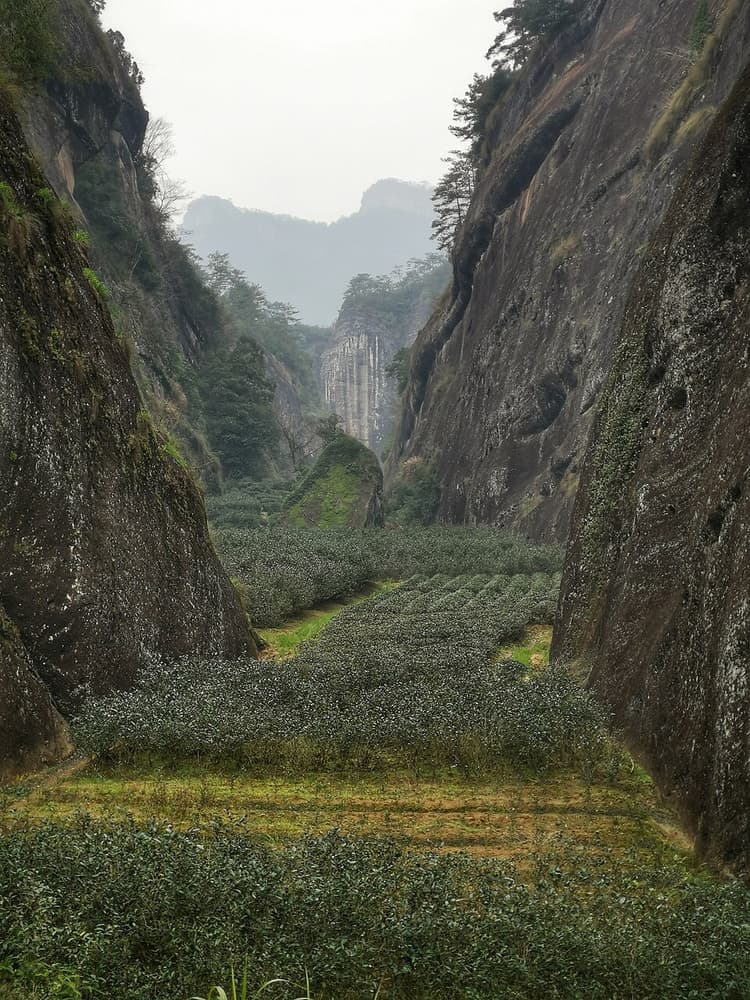
Tea cultivation gradually shifted into the Wuyi Mountains, where Buddhist and Taoist monasteries developed tea gardens carved into the rocky cliffs with intricate irrigation systems. During the Ming Dynasty, tea producers refined methods of controlling oxidation, allowing them to create partially oxidized teas. This eventually gave rise to oolong tea.
The Wuyi Mountains are also widely regarded as the birthplace of black tea. Lapsang Souchong, the world's oldest black tea, originated here and became one of China's first teas to gain widespread popularity in Europe.
By the 1700s, Wuyi teas were among the most sought-after teas in the Western world. They were even among the teas famously thrown into Boston Harbor during the Boston Tea Party. Later, Scottish botanist Robert Fortune smuggled tea plants and cultivation knowledge from China to British India. While he collected plants from several regions—not just Wuyi—his expedition played a major role in establishing India's tea industry.
Flavor
Wuyi teas are typically darker oolongs or black teas with medium to heavy oxidation. Many are charcoal roasted, producing rich notes of roasted nuts, minerals, cocoa, wood, and stone fruit. Different cultivars vary tremendously, making Wuyi tea one of the most diverse categories of Chinese tea
One defining characteristic of authentic Wuyi rock tea is yan yun (岩韵), or "rock rhyme," a distinctive mineral quality said to come from the unique rocky soil of the Wuyi Mountains.
Brewing
Because there is so much variety among Wuyi teas, brewing recommendations will vary depending on the specific tea.
As a general guideline, I recommend brewing them gongfu style using 4–5 grams of tea for 100 ml of water at 90–95°C for 10–15 seconds per infusion, gradually increasing the steeping time.
For a Western-style brew, use 2–3 grams of tea for 250 ml of water at 90–95°C for 2–3 minutes.
My Thoughts
I love Wuyi tea because it represents one of the oldest and most refined tea traditions in the world. Although there is an incredible amount of variety within this group, I have yet to find a Wuyi tea that I don't enjoy.
I was also fortunate enough to receive several Wuyi teas as gifts during my travels in China, which permanently cemented them in my heart.
My favorite Wuyi tea is Ma Tou Yan Rou Gui (马头岩肉桂).